


A novel β-defensin-like miniprotein from a sea anemone as a high-affinity inhibitor of mammalian α-amylases
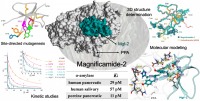
Our colleagues have reported the identification and structural-functional characterization of a novel miniprotein, magnificamide-2 (Mgf-2), isolated from the mucus of the sea anemone Heteractis magnifica. The study demonstrates that Mgf-2 is a highly potent inhibitor of mammalian α-amylases, including human enzymes, with inhibition constants in the picomolar range. For the recombinant form of the protein, Ki values were 0.029 nM for human pancreatic α-amylase, 0.057 nM for human salivary α-amylase, and 0.011 nM for porcine pancreatic α-amylase; these values indicate an efficacy several orders of magnitude higher than that of the approved drug acarbose.
Nuclear magnetic resonance analysis revealed that Mgf-2 adopts a compact β-defensin-like fold stabilized by three disulfide bridges. A flexible β1-β loop containing the 7YHYH10 motif plays a key role in enzyme binding; molecular dynamics and docking data indicate that this loop penetrates deeply into the α-amylase active site, forming an extensive hydrophobic interface with the hydrophobic "rim" surrounding the catalytic site. Contact analysis showed that tyrosine (Y9, Y13) and histidine (H10) residues, as well as alanine A28, contribute significantly to complex stabilization, a finding confirmed by site-directed mutagenesis. Replacing Y9 with alanine reduced affinity by approximately three orders of magnitude, whereas the H10R mutation, contrary to expectations, also significantly weakened inhibition, pointing to subtle steric and electrostatic constraints within the binding region.
It is important to note that Mgf-2 showed no activity against neuronal ASIC ion channels or voltage-gated sodium channels; this distinguishes it from many sea anemone toxins and reduces the risk of off-target effects. The developed heterologous production scheme in E. coli yields sufficient quantities of the protein for further preclinical studies. These findings not only broaden the understanding of the molecular mechanisms underlying the ultra-high-affinity inhibition of α-amylases but also provide a structural basis for the rational design of novel peptide-based drugs aimed at controlling postprandial hyperglycemia in type 2 diabetes. This work contributes to the development of glycemic control strategies utilizing natural protein inhibitors of marine origin.
The results have been published in the International Journal of Biological Macromolecules.