


A novel endo-fucoidanase for the selective production of anticoagulant oligosaccharides from brown algae
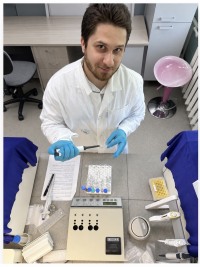
A team of researchers from PIBOC FEB RAS presented the results of identification and functional characterization of a new enzyme of the glycoside hydrolase family GH107 from the marine bacterium Winogradskyella eximia KMM 3944. The work demonstrates the possibility of targeted enzymatic depolymerization of α-(1,3)-L-fucoidans with preservation of specified sulfate patterns that determine anticoagulant activity.
Fucoidans, sulfated polysaccharides from brown algae, are considered promising agents for the correction of hemostasis, but their clinical use is limited by their high molecular weight, low oral bioavailability, and nonselective platelet activation. The solution to these problems is seen in the production of low molecular weight oligosaccharide derivatives with controlled structure, which requires enzymes with narrow substrate specificity.
In the W. eximia genome, the authors identified a gene cluster associated with fucoidan degradation, including three putative GH107 endofucanases: Wef1, Wef2, and Wef3. Using sequence similarity network analysis and molecular docking, Wef3 was predicted to preferentially bind 2,4-disulfated L-fucose residues (Fuc2,4S) at subsites −1 and +1, indicating the ability to hydrolyze α-(1,3)-glycosidic linkages between such residues.
The recombinant form of Wef3 showed optimal activity at pH 6.0–7.1 and 37 °C, without requiring the presence of divalent cations. Substrate specificity was verified on a panel of fucoidans of various structures: Wef3 effectively hydrolyzed α-(1,3)-L-fucoidans from Saccharina cichorioides (ScF) and Saccharina bongardiana (SbF), but showed no activity against α-(1,3;1,4)-L-fucoidans and galactofucans. At the same time, the enzyme also cleaved 2,3-disulfated decasaccharide with α-(1,3;1,4) bonds, which indicates catalytic promiscuity towards certain oligosaccharide substrates.
The enzymatic hydrolysis products of ScF and SbF were separated into high molecular weight (HMP) and low molecular weight (LMP) fractions and then further purified using anion exchange chromatography. NMR spectroscopy of isolated oligosaccharides (including trisaccharide α-L-Fuc2,4S-(1,2)-α-L-Fuc4S-(1,3)-α-L-Fuc2,4S and a C2-branched hexasaccharide) allowed us to establish a consensus cleavage site: Wef3 preferentially hydrolyzes bonds between Fuc2R4S residues (R = H or SO₃⁻) in subsites −1 and +1, also allowing for the presence of C2-substituted residues in subsites −3 and +1.
Evaluation of anticoagulant activity in human plasma (APTT, TT and PT tests) showed that native fucoidans and their HMP derivatives demonstrate a dose-dependent prolongation of clotting time, comparable to low molecular weight heparin (Clexane). The most pronounced effect was recorded for SbF and HMP-SbF: a doubling of APTT was achieved at concentrations of 6.37 and 4.34 μg/ml, respectively. LMP-SbF, enriched in Fuc2.4S residues (66% versus 36% in LMP-ScF), retained moderate activity (2APTT = 19.01 μg/ml), while LMP-ScF with a predominance of 4-sulfate fragments was practically inactive. This confirms that 2,4-disulfation is a key structural determinant of the anticoagulant effect, with molecular weight also making a significant contribution, especially in the TT test, which is dependent on thrombin inhibition via antithrombin III and heparin cofactor II.
Experiments on platelet-rich plasma revealed that high molecular weight fractions (native fucoidans and HMP) induce platelet aggregation, and the activity correlates with molecular weight. Low molecular weight LMP-SbF, despite its reduced mass (3.4 kDa), demonstrated a moderate proaggregant effect due to the high proportion of 2,4-disulfated residues. All samples inhibited ADP- and ristocetin-induced aggregation, and the inhibition was more pronounced for native high-molecular-weight forms, indicating the importance of multivalent interactions with GPIbα and CLEC-2 receptors.
The results obtained allow us to conclude that endo-fucanase Wef3 is the first representative of GH107 with confirmed selectivity for 2,4-disulfated residues in α-(1,3) bonds, which opens up the possibility of targeted production of oligosaccharide derivatives of fucoidans with a given sulfate profile. The demonstrated dependence of biological activity on the source of raw materials and enzymatic processing conditions emphasizes the need for an integrated approach in the development of low-molecular-weight anticoagulants based on fucoidans. These studies form the basis for further preclinical study of the resulting oligosaccharides as oral anticoagulants with a reduced risk of platelet activation.
The results were published in the International Journal of Biological Macromolecules.