


The marine bacterium Vibrio sp. KMM 9700 produces two sulfated O-specific polysaccharides
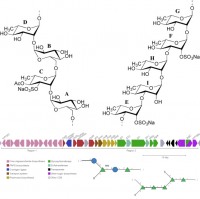
A comprehensive study conducted by researchers from the G.B. Elyakov Pacific Institute of Bioorganic Chemistry (TIBOC), Far Eastern Branch of the Russian Academy of Sciences, established that a strain of the marine proteobacterium Vibrio sp. KMM 9700, associated with the red alga Polysiphonia sp., simultaneously synthesizes two structurally distinct sulfated O-specific polysaccharides. This conclusion was reached through a combined bioinformatic analysis of the bacterial genome and structural investigation of the isolated compounds.
Initially, comparative genomics identified a gene cluster responsible for O‑antigen biosynthesis, within which two independent pairs of glycosyltransferase and sulfotransferase were discovered, allowing the prediction of two different sulfated polymers. Subsequent chemical analysis confirmed this assumption and enabled the complete elucidation of the primary structure of each.
The major polysaccharide was found to be built of tetrasaccharide repeating units with alternating 6‑substituted α‑D‑glucopyranose residues and 2‑substituted α‑L‑rhamnopyranose residues, where one of the rhamnose residues carries a sulfate group at O‑3 and an acetyl substituent at O‑4. The minor polysaccharide, in turn, is built of pentasaccharide repeating units consisting exclusively of α‑L‑rhamnopyranose residues, of which three are 3‑substituted and two are 2‑substituted; the sulfate groups are strictly located at two specific residues at O‑2.
Neither of the described polymers has previously appeared in bacterial carbohydrate databases, significantly expanding the known chemical diversity of the genus Vibrio. Of particular note is the presence of sulfate groups – a modification that is relatively rare in terrestrial bacteria but characteristic of marine microorganisms, as it increases the negative charge of the cell surface and is presumably involved in protection against bacteriophages, modulation of adhesion, and resistance to osmotic stress. Furthermore, one fragment of the major polysaccharide, (→2)-α-L-Rhap3S4Ac-(1→6)-α-D-Glcp-(1→), had previously been found in the capsular polysaccharide of another marine vibrio, V. chaetopteri KMM 8419ᵀ.
The co‑expression of two different sulfated O‑antigens in a single strain represents a rare example of phenotypic heterogeneity of surface glycans in Gram‑negative bacteria. The authors suggest that such a strategy may serve as an adaptive mechanism that enables the bacterium to interact more effectively with the multi‑component environment of the marine milieu and to withstand biotic and abiotic factors. The obtained results not only enrich fundamental knowledge of the structural organization of lipopolysaccharides from marine bacteria, but also lay the groundwork for further investigation of biosynthetic pathways and the functional role of sulfated O‑antigens in the ecology of microbial communities. At the same time, the authors stress that bioinformatic prediction, however informative, requires mandatory experimental verification by chemical methods to correctly interpret the structure.
The results are published in the journal Carbohydrate Research.