


Triterpene glycosides from sea cucumber Psolus phantapus exhibit selective activity against breast cancer cells
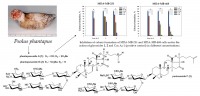
Results from a study of two new glycosides isolated from the sea cucumber Psolus phantapus have been published. The compounds, named phantapusosides A (compound 1) and B (compound 2), have attracted attention due to their ability to inhibit the growth of triple-negative breast cancer (TNBC) cell lines in vitro.
Both glycosides have hexasaccharide chains and the identical aglycones (16-keto-holost-7(8),25-diene-3β-ol). They differed from each other in the position of the sulfate group in the terminal 3-O-methylglucose residue: at C-6 in phantapusoside A, , and at C-4 in phantapusoside B. As the testing of cytotoxicity demonstrated, this structural feature influences biological activity. The panel of four human breast cancer cell lines (MCF-7, T-47D, MDA-MB-231, MDA-MB-468), as well as the non-neoplastic epithelial cell line MCF-10A and the pancreatic carcinoma cell line PANC-1 were used for checking of cytotoxic action of the glycosides. Phantapusoside B was found to exhibit a more pronounced cytotoxic effect than phantapusoside A. The IC50 values for compound 2 against MDA-MB-231 and MDA-MB-468 were 9.5 and 7.5 μM, respectively, while those for compound 1 were 14.4 and 13.8 μM. Furthermore, both glycosides were less toxic to non-tumorigenic MCF-10A epithelial cells (IC50 > 20 μM for compound 1 and 14.0 μM for compound 2).
The key result of the study was the colony-inhibiting data. Both compounds inhibited the ability of tumor cells to form colonies at doses significantly lower than those required to reduce metabolic activity. The MDA-MB-468 cell line (basal-like phenotype) was the most sensitive: at a concentration of 0.5 μM, phantapusoside B inhibited colony formation by 84%, and at 1 μM, by 95%. For the MDA-MB-231 cell line, the same concentrations caused inhibition of 47% and 88%, respectively. For the MCF-7 cell line, the effect was weaker, and PANC-1 showed the least sensitivity to both glycosides.
. It is noted that the presence of a bulky hexasaccharide chain appears to limit membranolytic activity, shifting the focus of action toward receptor-mediated signaling pathways that lead to the selectivity of the glycosides against TNBC cell lines.
This study contributes to our understanding of the structure-activity relationships among sulfated triterpene glycosides and confirms that the position of the sulfate group is an important factor influencing antitumor potential. However, as the researchers emphasize, the results were obtained in cell models and require further study, including in vivo experiments, before therapeutic application can be discussed.
The results were published in the journal Marine Drugs.