


Rare cyclic glycerophospholipids from starfish protect cardiomyocytes during hypoxia
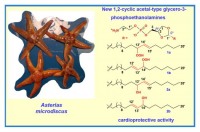
Researchers from the PIBOC FEB RAS studied the chemical composition of the Arctic starfish Asterias microdiscus, which lives in the Chukchi Sea, and discovered four new compounds belonging to a rare group of natural glycerophospholipids. These molecules, called acetal-type 1,2-cyclic glycero-3-phosphoethanolamines, possess an unusual structure, previously largely considered an artifact arising artificially during the lipid isolation. Only in the last couple of decades has it been recognized that the existence of such substances is natural in some marine organisms. The discovered compounds differ only in the location of the double bond, hydroperoxide or hydroxyl group within the long hydrocarbon chain, making their separation virtually impossible using current methods. Therefore, the scientists analyzed and tested them as a mixture.
Biological experiments on H9c2 rat cardiac muscle cells revealed that the mixture of these compounds alone is low in toxicity. When cardiomyocytes were exposed to the toxic effects of cobalt chloride, simulating chronic oxygen deprivation, the addition of starfish lipids significantly increased cell survival. This protective effect was demonstrated by the molecules partially restoring the membrane potential of mitochondria, the cellular powerhouses, which plummets during hypoxia.
This discovery not only expands our knowledge of the biochemical diversity of Arctic inhabitants but also lays the groundwork for the search for new natural cardioprotective agents aimed at maintaining cardiac cell health under conditions of oxygen deprivation.
The results were published in the journal Natural Product Research.