


A new species of bacteria, named after a prominent Russian microbiologist, has been discovered off the coast of the Sea of Japan
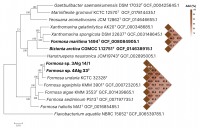
Scientists at our Institute have discovered a new species of marine bacteria, Formosa bonchosmolovskayae, isolated from the brown alga Saccharina japonica and the green alga Ulva fenestrata. These bacteria are capable of effectively degrading polysaccharides. The new species is named in honor of Elizaveta Aleksandrovna Bonch-Osmolovskaya, a distinguished Russian microbiologist, Corresponding Member of the Russian Academy of Sciences, and President of the Interregional Russian Microbiological Society, who made significant contributions to the study of microbial ecology.
The study also led to the reclassification of two known species: Formosa maritima and Bizionia arctica, which were recommended for transfer to the genus Xanthomarina.
The new bacteria are aerobic, Gram-negative, motile, yellow rods. Their key feature is the presence in their genome of a large set of enzymes capable of degrading complex algal polysaccharides, such as alginate in brown algae and ulvanin in green algae.
"Genetic analysis revealed that the strain isolated from brown algae contains gene clusters for the degradation of alginate and laminarin, while the strain from green algae contains a unique set for the breakdown of ulvan. This is a striking example of microorganism adaptation to their ecological environment," explain the authors of the study.
The scientists used a comprehensive approach: classical microbiological methods, complete genome sequencing, and analysis of fatty acids and polar lipids conducted by scientists from the NSCMB FEB RAS. This allowed them not only to describe the new species but also to clarify the taxonomic position of related species in bacterial systematics.
This discovery has implications for understanding the role of marine microorganisms in the global carbon cycle. Algal biomass-degrading bacteria play a key role in recycling organic matter in coastal ecosystems ‒ so-called "blue carbon" communities.
The type strain F. bonchosmolovskayae 4Alg 33ᵀ is deposited in the Collection of Marine Microorganisms (KMM) and the Korean Collection of Type Cultures (KCTC). Its genomic sequence is available in the international GenBank database.
The results were published in the journal Microorganisms.
This work was supported by the Russian Ministry of Education and Science (agreement no. 075-15-2025-467).